Classwork and homework
Exercise books are checked and signed. Persistent incomplete work brings a parent to the office, not a punishment.
Madina Tul Ilm Education
High School System
مدینۃ العلم ایجوکیشن ہائی سکول سسٹم، ملتان
Home › Academics
نصاب و تعلیم
Play Group to Class 10, following the Punjab Curriculum, with Classes IX and X prepared for the Matriculation examination of BISE Multan.
A child who joins us in Play Group can stay for twelve years without changing school. That continuity is the point. The teacher preparing a Class IX student for a board paper has usually taught that student's older brother or sister, knows the family, and knew this child in Class V.
We teach the Punjab Curriculum as issued, using the Punjab Curriculum and Textbook Board books that every government and partner school in the province works from. There is no parallel syllabus and no separate “special” stream — what we do is teach the actual syllabus properly, and make sure children are not carried forward without the reading and arithmetic they will need later.
The board papers our students will eventually sit are in English for science and mathematics. But a child who is taught only in a language they cannot yet think in learns to copy rather than understand. So English is built deliberately from Play Group onward — vocabulary, then sentences, then subject terminology — while explanation continues in Urdu wherever a concept is new. By the Middle section most instruction is bilingual; by Class IX students can follow and answer a paper in English.
Nazra Quran and Islamiat sit on the ordinary timetable, not outside it. The day begins with assembly and recitation. Islamiat is a board subject at Matriculation and is treated with the same seriousness as any other.
Ages roughly four to six. The year a child learns how to be at school.
Early Years teaching is spoken before it is written. Children learn to recognise and form Urdu and English letters and numbers to twenty, to hold a pencil, to sit in a group, to take turns, and to ask for what they need in words. Rhymes, counting games, colouring and simple storytelling do most of the work.
There is no admission test for entry at this stage and no reading expected on arrival. A child who cannot yet speak much is not behind.
What parents can help with: send the child every day, on time, having eaten. Regular attendance at this age matters more than anything done at home.
| Area | Covers |
|---|---|
| Urdu | Recognising and writing حروف تہجی, spoken confidence, simple words |
| English | Alphabet, phonic sounds, everyday vocabulary, first sentences |
| Number work | Counting to 100, number recognition, first addition |
| Islamiat & Nazra | Short surahs, duas, basic manners and cleanliness |
| General awareness | Colours, shapes, family, seasons, our neighbourhood |
| Physical & creative | Drawing, colouring, rhymes, drill and free play |
Ages roughly six to eleven. The stage that decides whether the rest is possible.
Everything after Class V depends on two things being genuinely in place: the ability to read fluently in Urdu and English, and confident arithmetic. We would rather slow down and secure those than push a child forward to fail later. Children who need extra reading support get it within the school day.
From Class IV, science and social studies become distinct subjects and written work increases. Class V ends with a full examination, and results are shared with parents directly.
| Subject | Classes |
|---|---|
| Urdu | I–V |
| English | I–V |
| Mathematics | I–V |
| Islamiat | I–V |
| Nazra Quran | I–V |
| General Science | III–V |
| Social Studies | IV–V |
| Drawing & handwriting | I–V |
Ages roughly eleven to fourteen. Subject teaching begins in earnest.
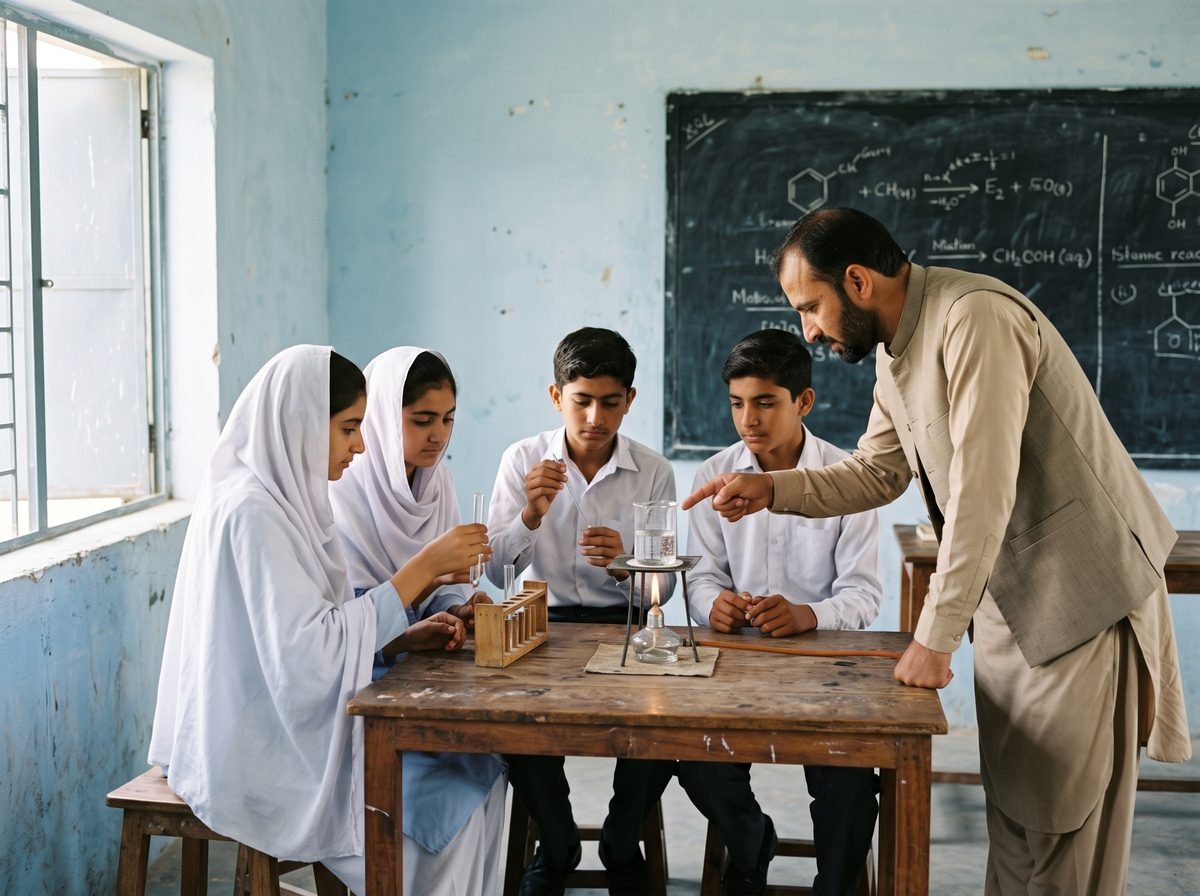
In the Middle section a class no longer has one teacher for everything. Mathematics, science, English, Urdu and Islamiat are taught by subject specialists, and Computer Studies begins. Science splits toward Physics, Chemistry and Biology content in preparation for Class IX.
Class VIII is the year we talk to parents about what comes next — specifically whether a student is heading for the Science or the Arts group at Matriculation. That conversation happens before Class IX begins, not after.
Girls continuing past Class VIII: this is the point at which many local girls historically left education. Our Secondary section exists in this same building precisely so that continuing does not mean travelling.
| Subject | Notes |
|---|---|
| Urdu | Grammar, composition, literature |
| English | Grammar, comprehension, composition |
| Mathematics | Algebra and geometry introduced |
| General Science | Physics, Chemistry and Biology strands |
| Islamiat | Board subject foundation |
| Nazra / Tarjuma | Recitation with meaning |
| Social Studies | Pakistan Studies foundation, geography |
| Computer Studies | Practical work in the computer room |
Ages roughly fourteen to sixteen. Two years assessed externally by the Board of Intermediate and Secondary Education, Multan.
Matriculation is a two-year, two-part examination. Class IX sits Part I and Class X sits Part II, and the two results combine into the certificate. Registration with BISE Multan is handled by the school; parents will be asked for the documents the Board requires, and we will tell you exactly what and when.
Students choose between the Science group and the Arts (General) group at the start of Class IX, on the basis of Class VIII performance and a conversation with the family. Both groups sit the same compulsory subjects.
Teaching in these two years leans heavily on past papers, the Board's own marking patterns, and timed practice under examination conditions — because a student who knows the material but cannot finish the paper still fails it.
Our Matriculation results by year: TO CONFIRM — to be published here once compiled from Board gazettes.
| Group | Subjects |
|---|---|
| Compulsory (both groups) |
Urdu · English · Islamiat · Pakistan Studies · Mathematics |
| Science group | Physics · Chemistry · Biology or Computer Science — with practical examinations |
| Arts / General group | General Science plus elective subjects offered by the Board |
Subject combinations available in a given session depend on Board notification and staffing. Confirm at the school office before Class IX registration.
Exercise books are checked and signed. Persistent incomplete work brings a parent to the office, not a punishment.
Short written tests per subject so a weak topic is caught in weeks rather than at the annual exam.
Full papers under examination conditions. Results are given to parents with the teacher available to explain them.
Annual examinations decide promotion. Separately, PEF's Quality Assurance Test examines our students externally.
The Punjab Education Foundation requires that 75% of the students it tests score at least 40% in every subject. It is a pass-everything threshold, not an average — which is why our teaching cannot afford to carry a weak subject quietly. Three consecutive failures would end the school's partnership.
Play Group to Class 10, free of charge, at Bawa Safra, Street No. 2.